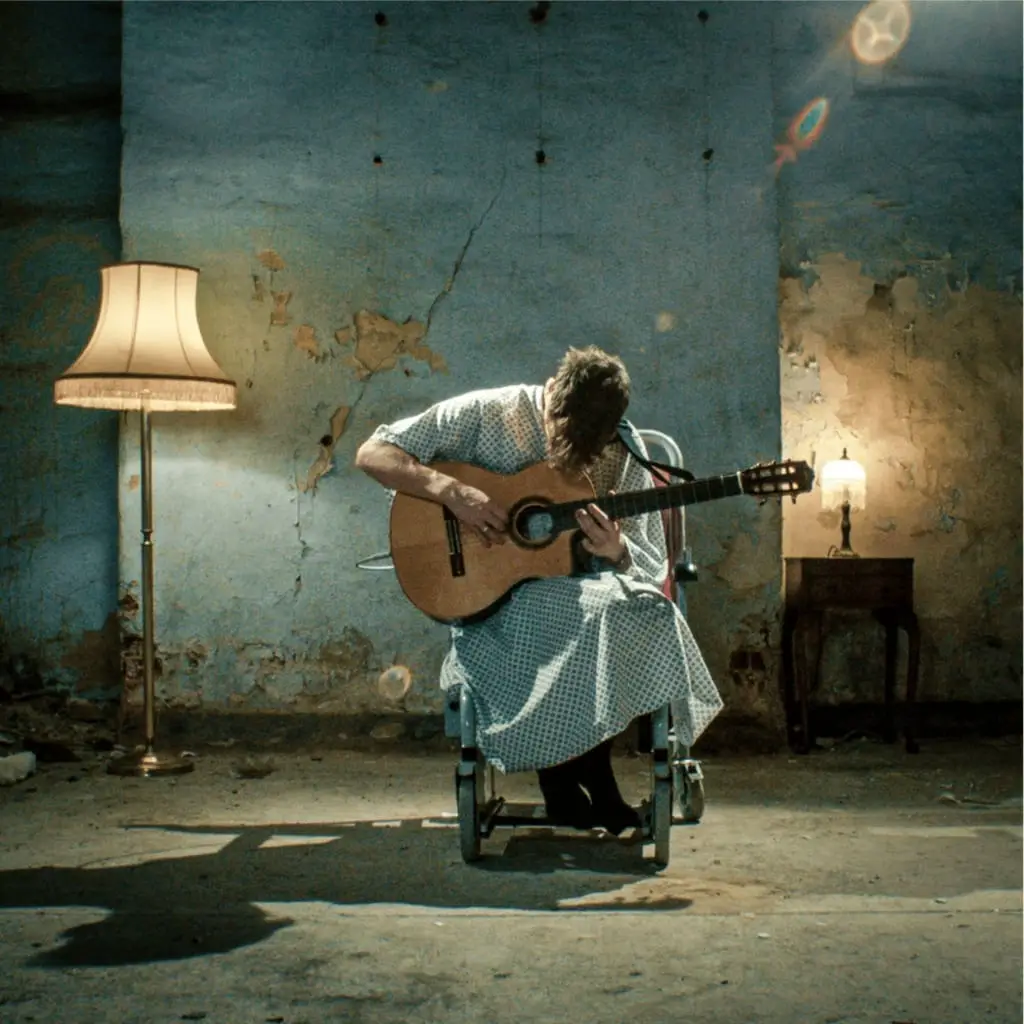
Ren’s song Hi Ren begins with a jarring confrontation: the self versus the shadow, the conscious versus the subconscious. In Carl Jung’s terms, this is the shadow self — the unacknowledged parts of our psyche that demand attention. Listening to Ren, I was reminded of my own Psychiatrist’s Chair series, where sitting becomes a visual metaphor for internal conflict.
Ren’s Hi Ren video opens with a striking image: the musician seated in a hospital gown, guitar in hand, in a stripped, decaying room. At first glance, the setting is clinical, yet it is also broken, evoking vulnerability and institutionalisation. In the same way, it mirrors my own use of the chair — not just as furniture, but as a stage where the psyche is laid bare.
This visual parallel reinforces the dialogue between music and photography. Both Ren and I use performance in confinement to expose confrontation with the shadow self. His stripped-down acoustic setting carries the same weight as my stark black-and-white frames: the chair as a site of tension, the body as both fragile and resilient.

Music and Psychology: The Shadow Self
Carl Jung described the shadow as the side of ourselves we repress, yet which holds the power to shape both our creativity and our fears. Ren’s dialogue with himself is not a gimmick but a lived psychological truth. His lyrics echo therapeutic exchanges — the tug-of-war between self-doubt, survival, and hope.
In my photography, the chair becomes more than furniture. Instead, it is a stage where the shadow self emerges: reaching hands, obscured faces, and the tension between concealment and exposure.
Ren’s Chair and Mine
In the video for Hi Ren, the stripped-back staging mirrors the vulnerability of therapy. Similarly, my Psychiatrist’s Chair series uses stark lighting, isolation, and gesture to explore the fragility of the human mind.
Where Ren finds his voice through music, I confront mine through imagery. As a result, both works become spaces where inner battles are made visible.

From Eminem to Ren: A Lineage of Artistic Confrontation
In a previous blog, In the Psychiatrist’s Chair: Eminem, Trauma, and My Artistic Voice, I reflected on how Eminem created alter egos to externalise trauma. Ren chooses direct confrontation. I chose staging through images.
Three artists, three mediums — but the same struggle:
- Eminem turned trauma into a voice that mocked and defended.
- Ren turned inner dialogue into performance with a guitar.
- I turned therapy into photographs where the body fights with absence.
This is not about mimicry but lineage artists across forms finding ways to confront their shadows without being consumed by them.
Northern Ireland: Local Context, Global Dialogue
I created these photographs in my home in Derry-Londonderry, but their meaning resonates far beyond geography. Still, there is something about making this work in Northern Ireland that matters. Here, trauma, silence, and resilience are part of the cultural landscape. Art is not just expression it is survival, healing, and testimony.
When I stage myself in the chair, I’m not only speaking to my personal shadow but also to a collective one. Ren’s music reminds me that shadow work is not solitary. It echoes through anyone who recognises themselves in the tension between despair and resilience.

Integrating the Shadow
Jung insisted the shadow cannot be destroyed only integrated. In my therapy, I learned the same. The chair became a stage where both ego and shadow could appear without one erasing the other.
Ren demonstrates this musically: the song closes not with triumph, but with acceptance. “It was never really a battle for me to win, it was an eternal dance.”
That line resonates deeply with my practice. In other words, my photographs are not victories; they are records of the dance smoke, hiding, reaching images of a dialogue that never fully resolves.
Final Reflection: Ren, Jung, and the Chair
Hi Ren gave me language for what my photographs had already been staging: the confrontation between ego and shadow. Jung gave me the framework to understand it. And my therapy gave me the courage to put it into practice.
Like Eminem before him, Ren proves that when the shadow speaks, it doesn’t always destroy. Sometimes, it creates. And in the psychiatrist’s chair whether through lyrics or photographs we learn not to silence the shadow, but to sit with it.
Q: What does Ren’s Hi Ren mean?
Ren’s Hi Ren is a dialogue between his conscious self and his shadow self, exploring themes of mental illness, resilience, and identity through confrontation.
Q: How does Carl Jung’s shadow theory connect to Hi Ren?
Carl Jung’s shadow theory describes the hidden parts of the psyche we repress. Hi Ren personifies this shadow as a voice that challenges Ren’s ego, echoing Jung’s idea of integration.
Q: How does art therapy relate to Ren’s work?
Like art therapy, Ren’s Hi Ren provides a safe container for difficult inner dialogue. Similarly, my psychiatrist’s chair series uses photography to externalise inner conflict.
Join Our Mailing list

©Teresa Lyle Media
Leave a Reply