The Return of Political Collage in a Time of Crisis
Estimated reading time: 7 minutes
Key Takeaways
- Political collage art surged during COVID-19 as a form of protest, reviving visual tactics from artists like John Heartfield.
- Documentary photography became crucial for witnessing reality, capturing feelings of abandonment and anger during the pandemic.
- Groups like Led By Donkeys used politicians’ words in public space to expose contradictions and hold power accountable.
- Collage art reflects the fragmented nature of trauma, offering a visual language that resists closure and embraces complexity.
- The legacy of political collage art persists, revealing truths needed in times of crisis and shaping our understanding of lived experiences.
Political collage art returned during Covid-19 as a form of protest reviving the sharp visual tactics of John Heartfield and reshaping them for today through groups like Led By Donkeys.
A creative reflection on protest, photography, and truth during COVID-19
When COVID-19 hit, the world didn’t just shut down it fractured. Streets emptied, hospitals filled, and daily life narrowed to windows, screens, and sirens. In that silence, many people reached for cameras. Not to beautify the moment, but to witness it.

Documentary photography surged because it had to. People photographed deserted cities, taped-off playgrounds, masked faces, and handwritten signs in windows. These images weren’t about perfection; instead, they were about proof. Proof that this happened. Proof that people felt abandoned, frightened, angry, and unheard.
At the same time, protest art re-emerged with force as protest collage.
Not polite protest. Not neutral protest. But accusatory, visual, impossible-to-ignore protest.
And collage messy, confrontational, historically political came roaring back.
COVID-19 and the Return of Visual Witness
Historically, moments of crisis produce new visual languages. During COVID-19, photography became both diary and indictment. Photographers documented government messaging, contradictions, and failures, while citizens shared images faster than institutions could control the narrative.
Importantly, this wasn’t only about aesthetics. Rather, it was about accountability.
In the UK especially, official slogans like “Stay Home. Protect the NHS. Save Lives” became visually charged objects repeated, layered, distorted, and eventually turned against those who issued them. As the gap widened between public instruction and political behaviour, artists responded in kind.
This is where political photomontage found its footing again.
Led By Donkeys: Modern Propaganda Turned Back on Power
Led By Donkeys rose to prominence by doing something deceptively simple: placing politicians’ own words back into public space.
Billboards. Projections. Posters. No commentary. Just receipts.

During COVID-19, their work sharpened. Government promises, timelines, and denials were juxtaposed against rising death tolls and lived reality. In doing so, Led By Donkeys revived a key principle of political collage: truth doesn’t need embellishment it needs framing.
John Heartfield and the Anatomy of Political Collage
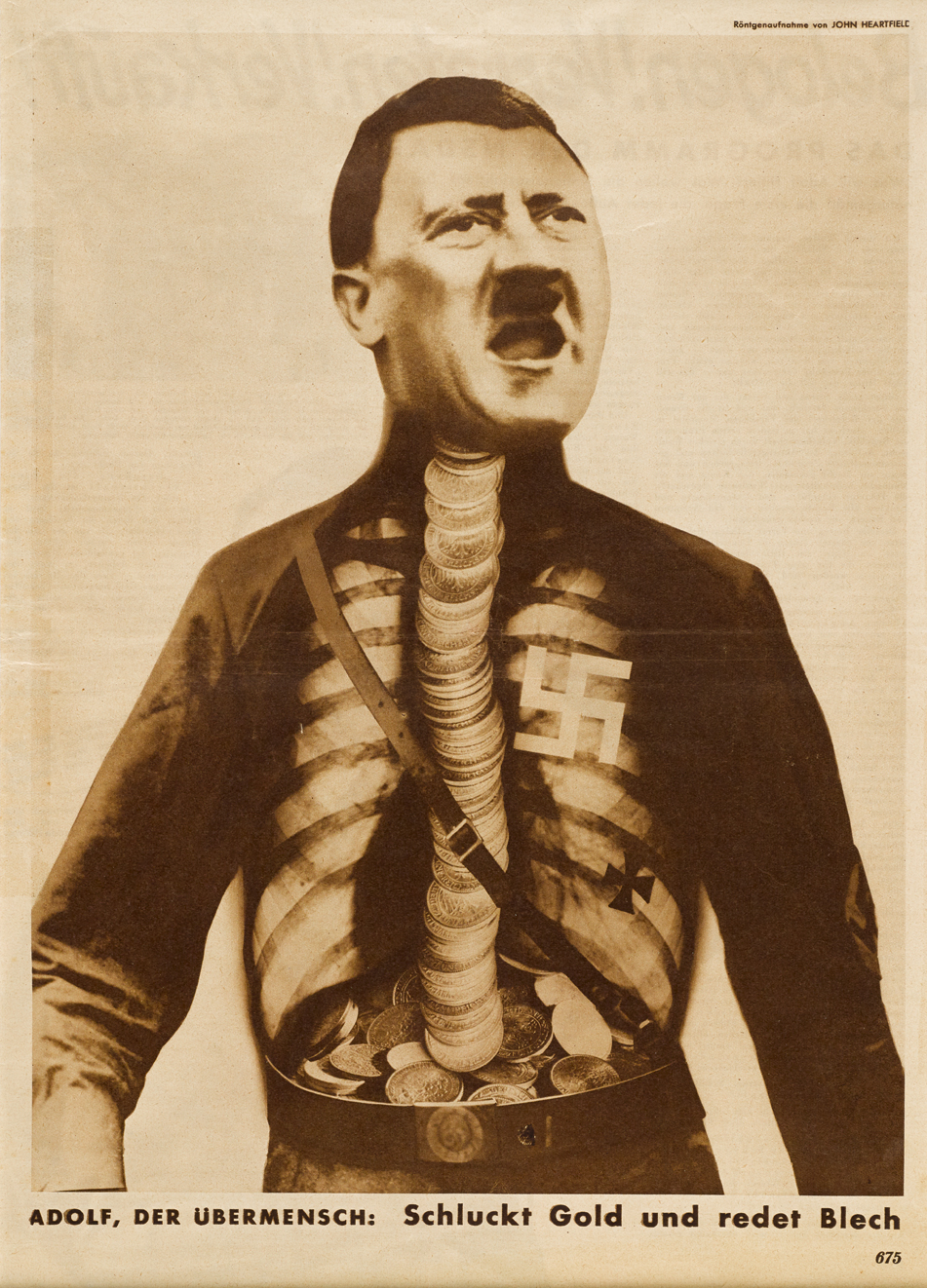
Long before Photoshop, John Heartfield understood the power of fragmentation. Working in 1930s Germany, Heartfield used political photomontage to dismantle fascist imagery, exposing how nationalism, capitalism, and violence were stitched together beneath the surface.

His technique was brutal and precise:
- Bodies opened to reveal machinery
- Leaders hollowed out and filled with money
- Symbols of pride turned into symbols of decay
Heartfield’s work wasn’t subtle and it wasn’t meant to be. It was designed to injure complacency.
That DNA is unmistakable in contemporary COVID-era protest art.
My Work: Collage as Psychological Protest
The political collage art I created during and after COVID-19 sit directly in this lineage. They use photography not as documentation alone, but as intervention.

Figures are split open. Faces are duplicated, eroded, or replaced.
National symbols are entangled with barbed wire, statistics, and skeletal forms.
These images weren’t created to explain policy they were created to expose harm.
One piece, installed guerrilla-style in a Belfast bus stop, deliberately removed itself from the safety of galleries and screens. It met commuters where contradiction lives: in public space, during routine, amid exhaustion. The work wasn’t asking for permission. It was asking a harder question:
Who absorbs the damage when leadership fails?

Protest Art After Trauma: Why Collage Still Works
Collage endures because trauma is not linear. Memory fractures. Trust splinters. Identity shifts. The elements that exist in activist collage.
Photography alone can sometimes feel too clean for that. Collage, however, mirrors the way crisis is experienced internally disjointed, overlapping, unresolved.
In the context of COVID-19:
- Protest art became a form of collective processing
- Documentary photography became a counter-archive
- Collage became a psychological autopsy
Together, they formed a visual language that refused closure.

Why This Matters Now
The pandemic may no longer dominate headlines, but its consequences remain embedded socially, politically, psychologically. Political collage art from this period is not historical ephemera; it is evidence.
Just as Heartfield’s work helps us understand the emotional mechanics of fascism, COVID-era protest art will help future generations understand how crisis was lived, mishandled, and resisted.
political collage art returns whenever power lies and whenever images are needed to tell the truth faster than words can.
Remember
From John Heartfield to Led By Donkeys, from documentary photography to guerrilla collage, COVID-19 reignited a visual tradition rooted in resistance. In moments when language is manipulated and accountability dissolves, artists reach for scissors, photographs, and public walls and they start cutting reality open.
Because sometimes, the most honest response to crisis is not explanation.
It’s exposure.
References & Further Reading
- Tate: John Heartfield and Political Photomontage – https://www.tate.org.uk
- Imperial War Museums: Art in Times of Crisis – https://www.iwm.org.uk
- Led By Donkeys official site – https://www.ledbydonkeys.org
- British Journal of Photography: COVID-19 and Documentary Practice – https://www.1854.photography
F.A.Q
What is political collage?
Political collage is artwork that uses cut imagery and recomposition (photographs, text, documents) to critique politics, expose propaganda, or communicate protest messages.
How did Covid-19 influence protest art?
Covid-19 protest art emerged due to public anger and grief, especially around government handling, lockdown policy, misinformation, accountability, and loss. It often used public interventions, typography, billboards, and collage.
Who are Led By Donkeys?
Led By Donkeys is a UK activist group known for public interventions that highlight political hypocrisy and government accountability, often using past statements and public records.
Who was John Heartfield?
John Heartfield was a German artist known for politically radical photomontage, using collage to fight fascism and propaganda in the early 20th century
Other Blogs
Join Our Mailing list
Enter your email below to receive updates.

©️Teresa Lyle Media
Leave a Reply